 GuerillaFi
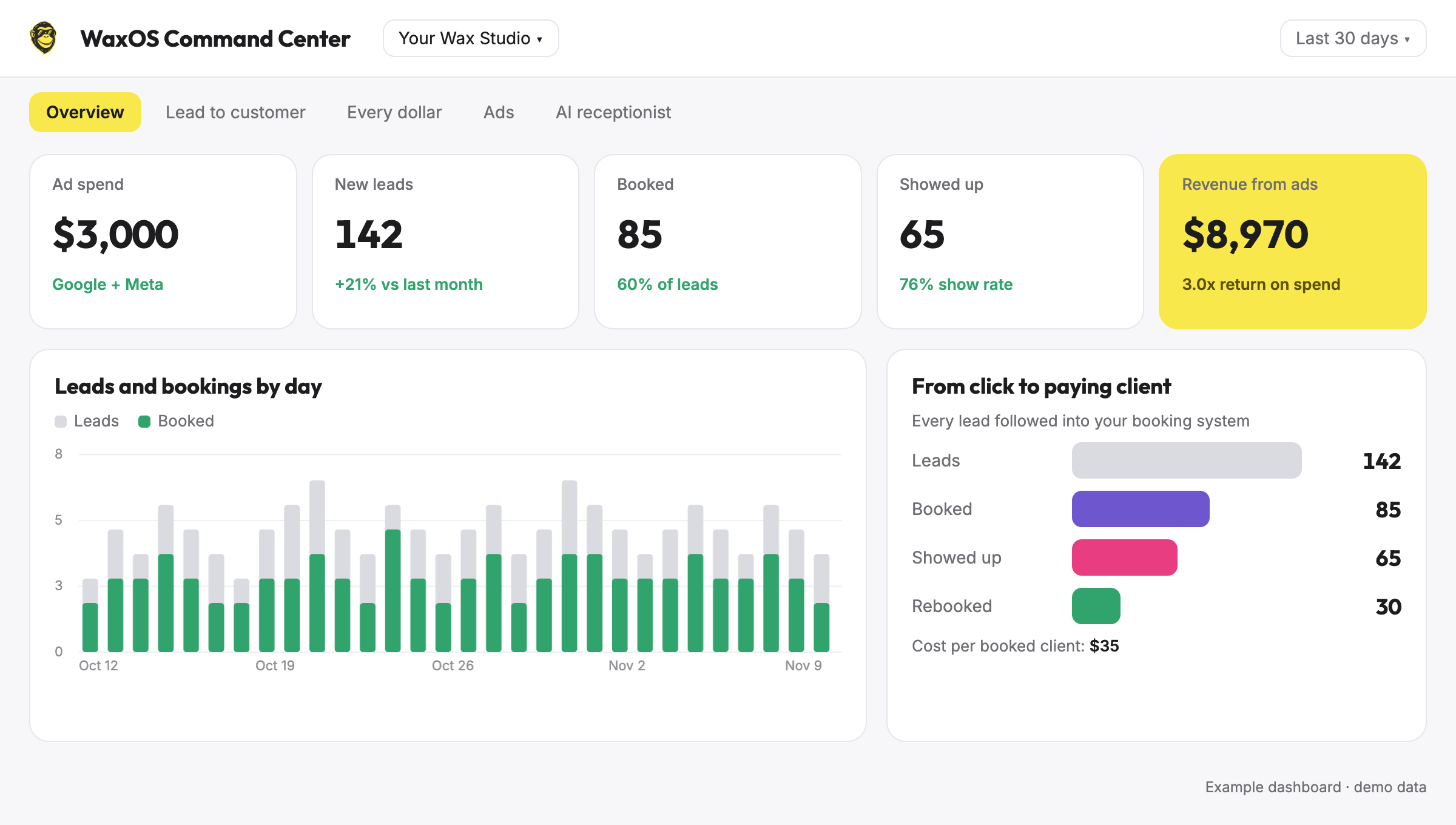
Most wax salon owners pick a Google Ads budget the same way: a round number that feels safe, like $500 or $1,000 a month. Then they judge the results by gut feel. A better way is to start with the number of new clients you want each month and work backwards. Four numbers decide what that costs: what you pay per click, how many clicks turn into leads, how many leads book, and how many bookings actually show up. This guide walks through that math step by step with a worked example. The example uses two real rates from Uni K Wax, a two-location studio we run marketing for: 70% of their Google leads booked and 93% of those bookings showed up. Every other number is an example you should replace with your own. By the end you will have a budget you can defend, plus a clear picture of which number to improve first if the ads feel expensive.
1. Start with the bookings you need, not the budget you want
Pick a monthly target for new clients from Google. Base it on real capacity: how many open slots your waxers have each week, and how many of those you want filled by first-time guests instead of regulars. A studio with two waxers and a full regular book needs a very different target from a new location with empty afternoons. Write the number down. Everything else in this guide is just the path from that number back to dollars.
Then decide what a new client is worth. A wax client is rarely a single visit. If your average ticket is $69 and a regular comes back every five weeks, one client who sticks around can be worth around ten visits a year. Not every new guest becomes a regular, so use your own return rate. If roughly half come back, a new client is still worth several hundred dollars in the first year. That number tells you how much you can afford to pay to win one, and it is almost always more than owners assume when they only look at the first ticket.
2. The four numbers that set your cost per new client
Cost per click is what Google charges when someone taps your ad. It depends on your city, your competition and how well your ads and landing page match the search. Google's Keyword Planner gives a rough local estimate for searches like "brazilian wax near me". Your click to lead rate is the share of visitors who call, text or fill out a form. A fast mobile page with a clear offer and an easy booking button does far better than a generic homepage.
Lead to booking rate is the share of leads who actually book an appointment. This is where most studios leak money. If a lead texts at 9 PM and nobody answers until the next morning, she has often booked somewhere else. At Uni K Wax, 70% of Google leads booked. Calls and texts are answered by an AI receptionist around the clock, and leads who don't book right away get a short series of follow-up texts and emails. Booking to show rate is the share of booked guests who walk in. Uni K's Google bookings showed up 93% of the time. Multiply all four together and you get your real cost per new client.
3. A worked example
Say you want 25 new clients a month from Google. Assume an example cost per click of $4 and an example click to lead rate of 10%. Use Uni K's real rates for the rest: 70% of leads book and 93% of bookings show. Each click produces 0.1 leads, each lead produces 0.7 bookings, and each booking produces 0.93 visits. That works out to about 0.065 new clients per click, or roughly 15 clicks per new client. At $4 a click, that is about $62 in ad spend per new client.
To get 25 new clients, you need about 385 clicks, which is roughly $1,540 a month in ad spend. Now change one number. If nobody answers leads quickly and only 35% book instead of 70%, you need twice the clicks for the same 25 clients, and the budget doubles to about $3,070. Same ads, same city, same keywords. The only difference is what happens after the lead comes in. This is why we look at the booking rate before we ever recommend raising a budget.
4. Why a tiny budget often costs more
A $300 monthly budget sounds careful, but it can be the most expensive option. Google needs enough clicks and conversions to learn who books. With only 75 clicks a month, a campaign may produce a handful of leads, and a single slow week can make the whole channel look like it does not work. Owners then turn it off before it ever had a fair test.
A better approach is to fund one focused campaign properly for a set period, usually 60 to 90 days. Keep it to your best services and a realistic driving radius around the studio. Track every lead through to a booked and attended visit. Once you know your real numbers, you can scale the budget with confidence or cut it based on evidence instead of a feeling. If money is tight, narrow the services and the radius rather than spreading a small budget thin across everything.
5. Where the money usually leaks
Broad keywords waste spend. Searches for wax products, waxing jobs or at-home kits can eat a budget fast, so review your search terms every week and add negative keywords. Location settings matter too. Make sure ads show to people who are actually in or near your service area, not people who once searched for your city from somewhere else.
The landing page is the next leak. Sending a "brazilian wax" ad to a homepage that makes the visitor hunt for the service and the booking button loses people. Send each ad group to a page that matches the search, shows the price or first-visit offer, and puts booking one tap away. The last leak is response time. A lead that waits hours for a reply is a lead you paid for and handed to a competitor. Fixing these three things often does more than adding budget.
6. Track bookings, not clicks
Google will happily report clicks and conversions, but a form fill is not a client. Connect your ads to the outcome that matters: a booked appointment and, ideally, a completed visit. That means tagging every lead with its source, tracking it in your CRM, and sending booked appointments back to Google so it learns which searches produce real clients instead of just form fills. When Google optimizes for bookings, it stops chasing the cheapest clicks and starts finding people who actually show up.
Review four numbers every month: cost per lead, lead to booking rate, show rate and cost per new client. Then improve the weakest one first. In the WaxOS system we run for studios, the Command Center shows those numbers side by side, and the AI receptionist answers every call and text in seconds, which is usually the fastest way to lift the booking rate. Whatever tools you use, the rule is the same: set your budget from the bookings you need, and judge it by the clients who walk in.